

The Sales Voicemail That Gets a Callback (Under 20 Seconds)
Monday morning, first dial of the week. It rings once... twice... four times. Then the beep.
You've got about half a second to decide what comes out of your mouth, and it's going on a recording they can replay whenever they want.
So you do what almost every rep does the first time. Your full name, your company, how long the company's been around, and how you'd love to "connect sometime." Forty seconds later you hang up, and the phone stays quiet all week.
Q4 starts Thursday. A big chunk of the dials you make between now and New Year's are going to end at that beep... so let's make the beep earn its keep.
Key Takeaways
- A sales voicemail that gets a callback runs under 20 seconds and says four things: who you are, one reason tied to them, when you'll call again, and your number twice, slow.
- The reason is what earns the callback. Make it something you could only say to this person, and keep the pitch for the live call.
- If they raised their hand, text them right after the tape so they can answer without dialing you back.
- Every voicemail is one of the 100 attempts in your 100/10/2. Log it and call back when you said you would.
- When they call back, answer with your name and the reason you left on the tape, then ask one real question.
What should a sales voicemail say?
Four lines, in this order. It's the same voicemail I put in my Sales Scripts & Follow-Up Cadence Library, and it fits under 20 seconds if you don't pad it:
"Hey [Name], it's [you] with [company]. I'm calling about [the one thing tied to them]. I'll try you again [day and time]. If it's easier, call or text me at [number]... again, that's [number]."
Now the why behind each line.
Who you are. First name and company, quick. They decide in the first couple seconds whether you're a person or a robocall, so sound like a person!
The reason. This is the line that EARNS the callback. It has to be one sentence you could only have said to this person.
"You asked for a quote on the Tacoma" or "you grabbed the pricing sheet Thursday night" makes them wonder what you've got. "I wanted to tell you about our services" makes them reach for delete.
When you'll call again. Say the day. It tells them you're coming back either way, and some folks would rather call you on their own terms than get caught off guard.
Your number, twice. You've been the person replaying a voicemail three times to catch a number someone rattled off like an auctioneer. Say it slow enough to write down, then say it again.
That's the whole tape. The pitch waits until they're on the line, because a voicemail has one job: getting you a conversation.
Why don't prospects call back sales voicemails?
Because most of the voicemails they get are about the caller. The company and the "quick minute of your time." They hear it in the first line, and they're gone.
Length finishes off the rest. When the tape runs long, they quit listening before your number ever shows up... and now even the ones who wanted to call you back can't.
I'd love to hand you a callback rate right here. You'll find percentages floating around online, and I haven't seen one with a source I'd stake a paycheck on, so I'm leaving it out.
Your own CRM will tell you more in two weeks than any number I could quote. Log every voicemail as its own outcome and watch what comes back.
And if you'd rather hit fewer beeps in the first place, how to get leads to answer the phone is the step before this one.
How long should a sales voicemail be?
Under 20 seconds. Read your script out loud with a timer running, and cut words until you beat it.
If you can't get under 20, the reason's too long. Trim it until it sounds like something you'd say to a buddy in the hallway.
Write it down before the calling block starts, too. Winging it at the beep is how you end up with three "ums" and a phone number you mumbled once.
Then leave a couple of practice tapes on your own voicemail and listen back. It's painful! It's also the fastest fix you'll make all week.
What should you text after leaving a voicemail?
If they raised their hand (filled out a form, asked for a quote), send a short text right after the beep while your name's still fresh.
The voicemail gives them your voice. The text gives them a way to answer without calling you, and for a lot of leads that's the easier door to walk through.
"Hey [Name], it's [you] with [company]. Just left you a voicemail about [the reason]. If texting's easier, I'm right here."
Keep it to the reason you gave on the tape and leave the pitch out. More templates, plus the timing behind them, are in my sales follow-up text message templates.
For a truly cold number, let the voicemail carry it and call again on the day you promised. A text from a stranger they've never heard from tends to hurt more than it helps.
Is leaving a sales voicemail worth it?
Yes. And the thing that keeps you dialing on a slow Monday is simple... a voicemail counts.
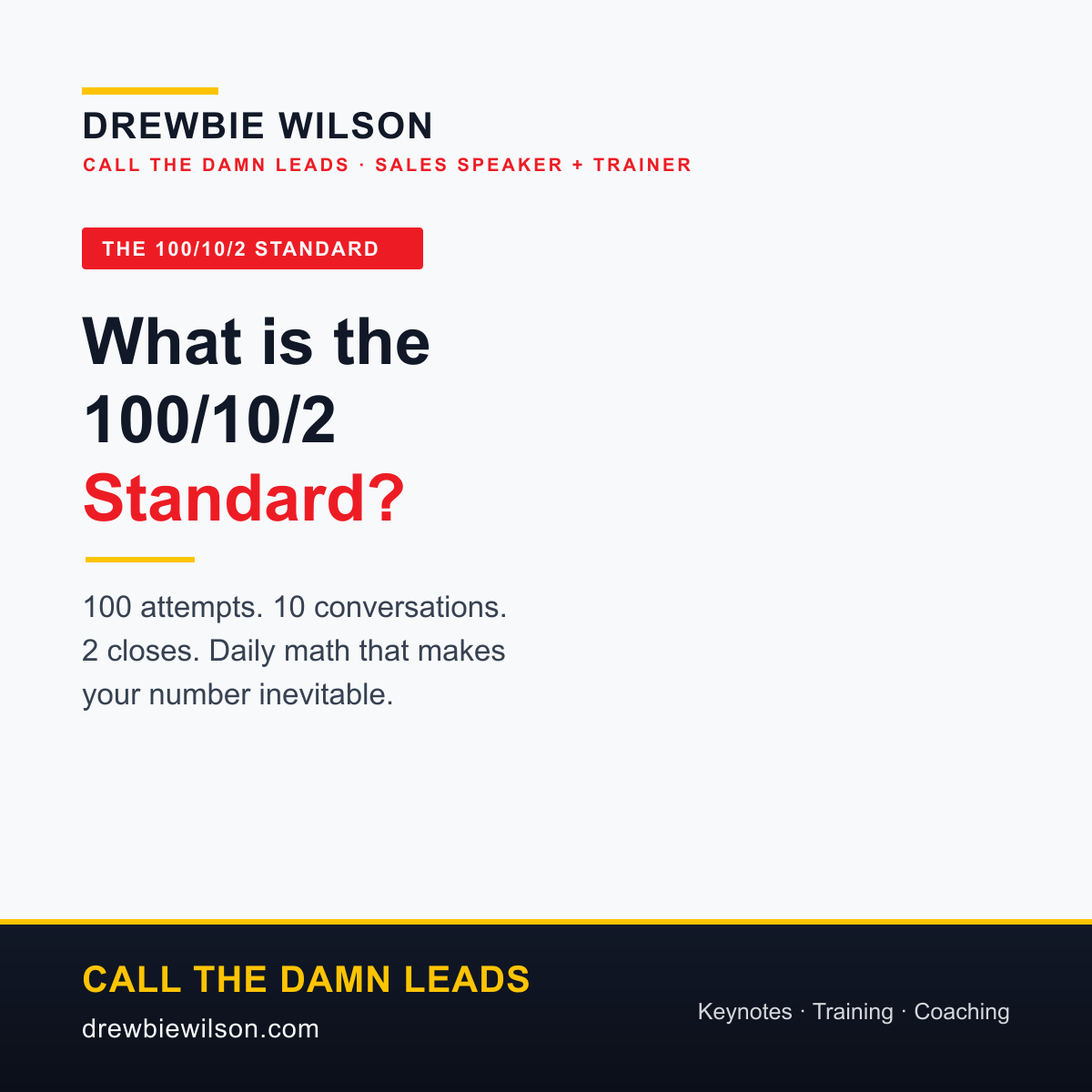
My 100/10/2 standard is 100 attempts, 10 serious conversations and 2 closes (or 2 deals added to the pipeline) every day. A voicemail is an attempt. It goes on the board.
The way I've always put it: "If I hit any 2 of those 3 metrics in a day, over 30 days it's almost impossible not to hit quota."
Plenty of those 100 dials are going to end at the beep. If you only score the calls where someone says hello, you'll feel like you're losing all day, and you'll quit by lunch. Count the attempts and the beep stops feeling like a loss.
And every voicemail is touch one of a sequence. The C.A.L.L.S. sales framework from my book Call The Damn Leads exists so you never quit after one text, and one voicemail deserves the same treatment.
Call again on the day you said you would. When you show up Wednesday like the tape promised, your next voicemail starts to mean something.
What do you say when a lead calls you back?
Plan for this one, because the callback always lands while you're mid-dial or halfway through lunch.
Answer with your name and the same reason you gave on the tape. "Hey, it's [you], thanks for calling me back! I'd reached out about [the reason]."
They called because of that sentence, so hand it right back to them. Then ask one real question about their situation and let them talk. The rest of that call lives in how to start a call with a lead.
One habit makes this easy. Put a one-line note in the CRM with exactly what you said on every voicemail, so when the phone rings three days later you know in one glance why they're calling.
A voicemail opens the loop. The money's in closing it.
When you're ready to get sharper at everything that comes after the first touch, grab Closing the Loop, my sales training on follow-up and closing. It's $297.
Write your four lines before your next calling block. Then go CALL THE DAMN LEADS!!!


Leave a comment