

What to Say When a Lead Says "Just Email Me"
You get them on the phone. You are three sentences into the thing you actually called about, and they cut you off with five words that end the conversation without ending the conversation.
"Just email me the info."
And you say sure. You get an address. You hang up feeling like you did your job, because technically you made contact and technically there is a next step. Then you send a beautiful email with an attachment and a calendar link, and you never hear from that human being again.
Here's the deal. "Just email me" is a polite exit. It works on us because it hands us a way off a call we were already a little nervous to be on, and we take it fast, before they change their mind.
If they'd rather text than talk, I keep the follow-up texts I send when a lead goes quiet on their own page.
Key Takeaways
- "Just email me" is a soft exit. Treat it as the first objection of the call, because that is what it is.
- Agree to send something, then earn one more question before you hang up. The question is the whole play.
- Ask what specifically they want in the email. Either they tell you, which gives you their real problem in their own words, or they cannot answer, which tells you the interest was never there.
- Send one short email that answers the question they gave you. One link at most.
- Book the next contact before you get off the phone. An email with no appointment behind it is a lead you have handed back to the pile.
Table of Contents
- What "Just Email Me" Actually Means
- What Happens After You Cave
- What to Say, Word for Word
- Run It Through C.A.L.L.S.
- When the Email Really Is the Right Move
- The Part Nobody Wants to Hear
- Your One Action Step for Today
What "Just Email Me" Actually Means
Put yourself on the other end of the phone for a second. Somebody you do not know is talking to you about something you did not schedule time for, and you have four other things going on. You do not want to be rude. You also do not want to keep talking.
So you reach for the most socially acceptable off-ramp in business. Send it over. It costs you nothing, it keeps you the good guy, and it moves the whole thing into a folder you will never open.
That is what you are hearing. Something a lot closer to "I would like this to be over, and I would like to be nice about it."
Which is fine! People are allowed to be busy. They said the thing anybody would say. What happens in the next thirty seconds is where the deal gets won or handed back, and that part belongs to you.
Because there is a version of this where they genuinely do want the information, and you cannot tell the two apart from the words alone. Same five words, two completely different situations. What separates them is the question you ask next.
What Happens After You Cave
Here is the sequence, and you have lived it.
You take the address. You hang up. You spend twenty minutes writing something good, because you want it to land. You attach the deck. You paste the calendar link. You hit send and you feel productive.
Then nothing. So you follow up. Nothing. You follow up again and now you feel like a pest, so you stop, and that lead sits in the CRM as "emailed" forever, which is the most useless status in sales. It looks like progress in a report and it is worth exactly zero dollars.
And the worst part is what it does to your head. You got told later, which is so much easier to sit with, so you sit with it. Twenty of those in a week and you have a pipeline built entirely out of people who were too polite to turn you down.
I have said it on stage and I will say it here. Follow-up is where the money lives. And chasing an email nobody actually wanted is a ghost you built yourself, on purpose, because it was easier than asking one more question.
What to Say, Word for Word
Agree with it. Out loud, immediately, no hedging. The move that gets you remembered as pushy is arguing the point, so skip "well, I would rather walk you through it" entirely.
Agree, then ask one more question before you hang up. Say this:
"Absolutely, I can do that. So I do not send you a bunch of stuff you do not need, what is the one thing you would want to see in there?"
That is it. That is the whole play. Read what it does.
You said yes, so there is nothing to push back on. You gave a reason for the question that is about THEIR time. And you asked for one thing, which is easy to answer.
Now one of two things happens, and both are wins.
They answer. "Honestly, just pricing." "Whether you work with shops our size." "How fast you can start." Now you have their real problem, in their own words, which is worth more than anything in your deck. And you are back in a conversation. Ask the follow-up. You are selling again.
They cannot answer. "Uh, whatever you have." "Just, you know, the general info." That is your answer too, and it is a gift. There is no interest here. Spend three lines on it, log it honestly, and go call somebody who will talk to you.
Either way you leave with something. Compare that to "sure, what is your email," which leaves you with a string of text.
Then, before you hang up, get the next contact on the books. "I will get that over this afternoon. I am going to give you a ring Thursday morning to see if it answered the question, does nine work or is later better?" You are agreeing on a time, out loud, while you still have them.
And when you do send it, keep it SHORT. Answer the one thing they named. One link at most. Send the brochure wall and you have proven their instinct right, that this was always going to be a lot of reading, and you have taught them not to open the next one either. If you want the actual structure for that message, we broke it down in what to send in a sales follow-up email and when to send it. Send that one.
Run It Through C.A.L.L.S.
This is just the framework running its course on a call that tried to end early.
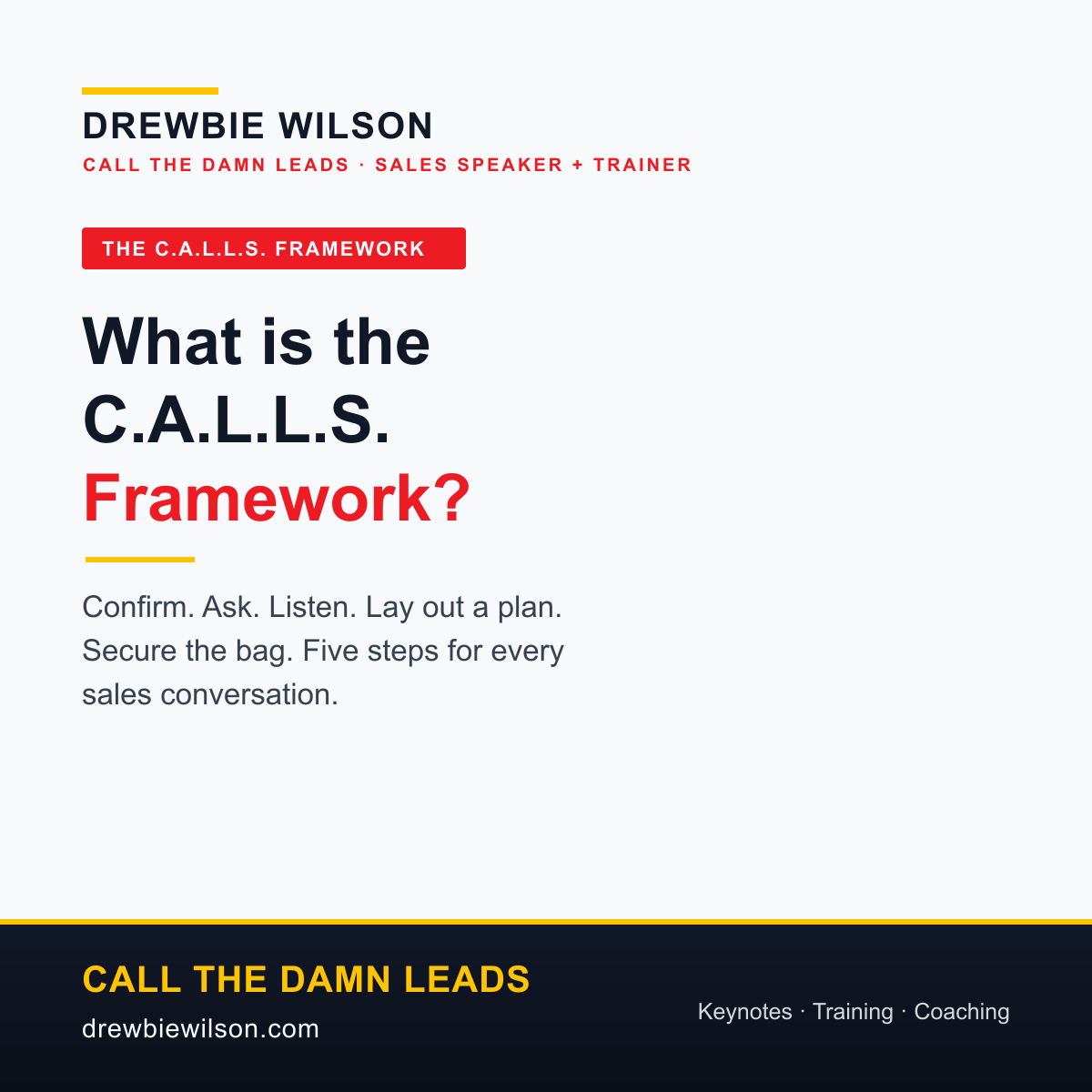
Confirm. "Absolutely, I can do that." You take the ask seriously and the temperature drops immediately.
Ask. "What is the one thing you would want to see in there?" One question, aimed at what they need.
Listen. This is the one people skip. Whatever they say next is the sale. Let them finish, then repeat it back so they know you got it.
Lay out a plan. "I will send that over this afternoon and call you Thursday at nine." Now there is a process where there used to be a hope.
Secure the bag. Sometimes that is the close. More often, on this call, it is the appointment. Take the appointment.
The whole point of the C.A.L.L.S. framework is that you keep going after one text, one email, or one soft brush-off. "Just email me" is the brush-off it was built for.
Shane, who runs a business we worked with, described the before-picture better than I could: "We had leads coming in consistently, but like most businesses, follow up wasn't as tight as it should've been. Opportunities were slipping through the cracks." That is what a pipeline full of emailed-and-waiting looks like from the owner's chair. And the thing he named as the fix was having a process, so there is "no more guessing what to say or when to say it."
When the Email Really Is the Right Move
Let me be fair here, because plenty of people mean it.
They are walking into a meeting. They are on a roof. They have a partner who makes these calls and they genuinely need something forwardable. You will know because they answer the question fast and specifically, and often they tell you when they plan to look at it.
Send it. Send it that day. Make it short, make it match what they asked for, and put the next call on the calendar anyway.
The test is whether they can tell you what they want in it. That one question sorts the whole pile for you, every time, and it takes about eight seconds.
There is also a version where they will not get back on the phone at all, and the phone is still where this gets solved. If that is the pattern you are fighting, start with getting leads to answer the phone, because no email script fixes a connect-rate problem.
The Part Nobody Wants to Hear
I want to go back to something from the top, because it is the real reason this objection works.
Most of the time, we are relieved to hear it.
The call was uncomfortable. We were not fully sure what we were going to say next. And then they hand us a way out that lets us feel like we made progress, so we take it. Nobody wants to admit that. I did it for years.
Which means the script is the easy part. Four seconds of work. The rest of it is being willing to stay in a conversation about thirty seconds past the point where it got awkward, and that is a rep thing you build by doing it.
Same muscle as picking the phone up in the first place. Shrink the stakes. Score attempts instead of outcomes. Ask one more question than feels comfortable, twenty times a day, and in two weeks it stops feeling like anything at all.
If "just email me" is the objection that gets you, its cousin is going to get you too. Same shape, same instinct to let the person off the hook. We wrote that one up separately: "I need to think about it". Read them back to back and you will see it is the same thirty seconds both times.
Your One Action Step for Today
Pick the phrase and say it out loud five times before your next call block. Out loud, not in your head.
"Absolutely, I can do that. So I do not send you a bunch of stuff you do not need, what is the one thing you would want to see in there?"
Then use it on the very next person who tries the exit. Whoever that turns out to be.
Do it ten times this week and you will find out something uncomfortable and useful: a chunk of your "warm" pipeline cannot name one thing they want from you. THAT IS GOOD NEWS. You just got those hours back, and you got them back this week instead of at the end of the quarter.
The frameworks in here all come out of Call The Damn Leads, if you want the rest of them in one place.
One question, and the willingness to ask it while it is still a little awkward, will run this on its own…
Call the damn leads. And when they try to send you to your inbox, ask them what they want in it first.


Leave a comment