

Automotive Sales Process: 10 Steps to Close More Leads in 2026
The numbers don't lie. Ninety percent of car buyers research online before they ever set foot on your lot, yet more than half still complete their purchase in person. So deals are still won or lost on your floor. The problem is that most salespeople are still running a playbook written for a buyer who no longer exists. This is a repeatable automotive sales process for the informed customer. It moves fast, closes more leads, and you can start using it today.
Key Takeaways
- Ninety percent of car buyers research online first, and the average buyer visits only 1.2 dealerships, so you get one shot at the deal.
- CDK research shows customer satisfaction drops sharply once the process runs past two hours, so speed is a competitive weapon.
- Only 56 percent of buyers rate the F&I stage positively, which makes it the single biggest leak in the funnel.
- On the walk-around, use the "because" technique to tie each feature to something the customer told you in discovery.
- Stay quiet for the first 60 seconds of the test drive, then ask where they see themselves driving the car next weekend.
Table of Contents
- Why the Old Automotive Sales Process Fails in 2026
- The 10-Step Automotive Sales Process (Updated for the Modern Buyer)
- The 2-Hour Rule: Why Speed Is Your Secret Weapon
- Post-Sale: The Missing Step in Most Automotive Sales Processes
- Frequently Asked Questions
- Stop Winging It. Start Closing.
Why the Old Automotive Sales Process Fails in 2026
The old model relied on information asymmetry. The salesperson knew the invoice price, the holdback, the incentives, and the customer knew almost nothing. That advantage is dead. Customers walk in knowing MSRP, invoice estimates, dealer incentives, and what three competitors are charging within a 50-mile radius. They've watched video reviews, read forum threads, and probably know the torque specs better than you do.
The average buyer visits only 1.2 dealerships before purchasing. You get one shot. If the experience drags, they leave. CDK research confirms that customer satisfaction drops sharply when the process exceeds two hours. Speed is a competitive weapon.
Then there's the F&I problem. Only 56 percent of buyers rate the finance and insurance stage positively. That makes it the single biggest leak in the entire funnel. You can execute nine perfect steps and lose the customer at step ten because the F&I office feels like a pressure cooker. Fixing this step alone can lift your close rate by double digits.
Guiding the buyer is now the baseline expectation. Customers need a translator who can connect the features they already know about to the life they actually live.
The 10-Step Automotive Sales Process (Updated for the Modern Buyer)
Step 1 – Meet & Greet: The 30-Second Impression
The first 30 seconds determine whether the next two hours happen at all. Ditch the hard pitch and the canned opener. Walk up with a low-pressure observation about the vehicle they are looking at. Something as simple as, "That color looks sharp in the sun," signals that you're a human being.
Use the approach angle rule. Never approach head-on. Come from the side or at a slight angle. Head-on approaches trigger a fight-or-flight response. A side approach feels collaborative, like you're walking up to look at the car together.
Qualify immediately but casually. Ask if they're shopping today or still in the research phase. Both answers are fine. The goal is to match your pace to theirs. Mirror their energy level. High-energy buyers want enthusiasm. Analytical buyers want data and space. Read the room and adjust.
Step 2 – Discovery: Uncover the "Why" Before the "What"
Most salespeople jump straight to inventory questions. What color? What trim? What budget? Those are surface-level. The real discovery happens when you ask needs-based questions. "What does your typical week look like?" tells you more than "What are you looking for?" ever will. A customer who commutes 60 miles a day needs fuel economy and comfort. A customer who hauls kids to soccer practice needs cargo space and safety ratings.
Identify the decision-makers in the group. A silent spouse can kill a deal faster than a bad credit score. If someone is hanging back, pull them in with a direct question. "How do you feel about the cargo space back here?" If they are not engaged, the deal is not real.
Listen for budget anchors. Phrases like "I don't want to spend more than X" or "I need a low payment" are gold. They tell you exactly where the numbers conversation needs to land. This is also the right moment to introduce the $3,000 rule as a trust-building tool. Explain that total ownership costs include insurance, maintenance, and unexpected repairs. Show the buyer you care about their long-term financial health. That conversation alone can separate you from every other salesperson they talk to.
Step 3 – The Vehicle Walk-Around: Feature-to-Benefit Translation
Don't read the window sticker. The customer already has that data on their phone. Your job is to translate features into benefits that solve the specific problems you uncovered in Step 2.
Pick three to five key features and connect each one directly to something the customer told you. Use the "because" technique. "This car gets 30 MPG highway because you mentioned your long commute." That sentence lands differently than "This car gets 30 MPG highway." The word "because" creates a logical bridge between the feature and their life.
Let the customer touch and open everything. Getting their hands on it builds ownership desire. Pop the hood. Fold the seats. Open the sunroof. Every physical interaction makes the car feel more like theirs.
Step 4 – The Test Drive: The Emotional Hook
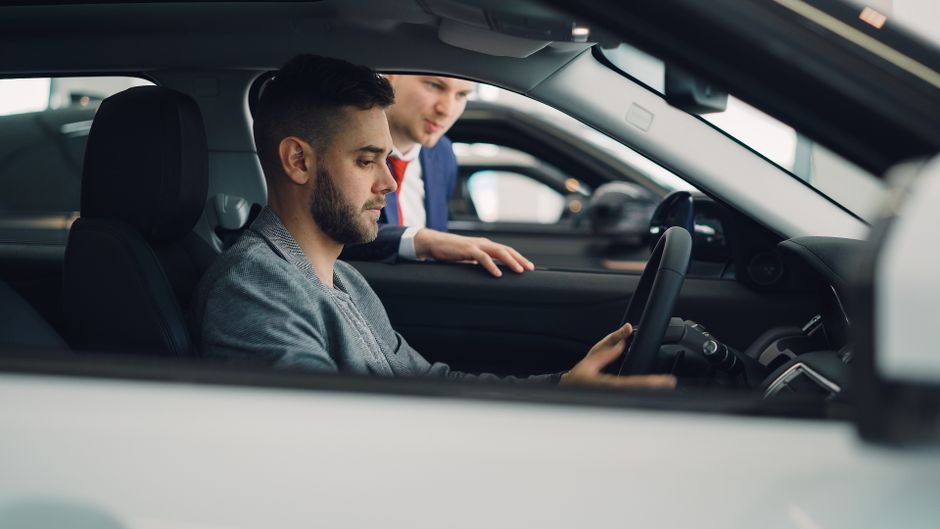
The test drive is the most important moment in the entire automotive sales process. This is where logic meets emotion. If the customer doesn't picture themselves owning the car during this drive, no amount of negotiation will save the deal.
Plan the route in advance. Include highway merging so they feel the acceleration. Include a bumpy road so they feel the suspension. Include a quiet residential street so they can imagine pulling into their driveway. A mixed route tells a complete story.
Go silent for the first 60 seconds of driving. Let the customer process the experience without your narration. They need to hear the engine, feel the steering, and form their own impressions. Your voice during that first minute is noise.
After the drive, ask a future-oriented question. "Where do you see yourself driving this next weekend?" That question plants a mental image of ownership. It shifts the conversation from "if" to "when."

Step 5 – Post-Drive Discovery: Confirm the "Yes"
Do not jump straight to price. The emotional high of the test drive is still settling. Ask a scaling question: "On a scale of one to ten, how does this feel compared to what you expected?"
If they say anything less than a ten, ask what would close the gap. If they say seven, find out what would make it a ten. Maybe it is a different color. Maybe it is a sunroof. Maybe it is just reassurance about reliability. Address the hesitation before you ever talk numbers.
Re-confirm the timeline. "If we can make the numbers work today, is there any reason you wouldn't drive this home?" This question surfaces hidden objections before you invest time in the negotiation.
Step 6 – The Service Introduction: Sell the Relationship, Not the Car
Introduce the customer to a service advisor before they buy. Walk them through the service bay. Show them the waiting area. Explain the complimentary maintenance plan, loaner car policy, or shuttle service.
This single step builds trust and reduces post-purchase dissonance. The customer sees that you're inviting them into a long-term relationship. It also opens the door for future service retention and upsells. A customer who knows their service advisor by name is a customer who comes back for oil changes, tire rotations, and eventually their next vehicle.
Step 7 – The Numbers: Transparency Wins
Use a physical or digital worksheet with every line item visible. MSRP, discounts, rebates, taxes, fees, trade-in value, total out-the-door. Hidden fees are the fastest path to a walk-out. Customers have access to pricing data. If your numbers don't add up, they'll know.
Break everything down line by line. Explain what each fee covers and why it exists. If there is a doc fee, say so and explain it. Transparency disarms suspicion.
If the customer seems stretched, revisit the $3,000 rule conversation from Step 2. Show them what total monthly ownership looks like with insurance, fuel, and maintenance factored in. Help them understand the full picture. A customer who feels educated is more likely to commit.
If they balk at the price, don't discount immediately. Revisit the value of the features they loved during the walk-around and test drive. Remind them why this car is worth what it costs before you start cutting numbers.
Step 8 – Negotiation & Objection Handling
Objections are requests for more information. Handle them systematically.
For price objections: "I understand. What if we look at a different trim level that still has the features you need?" This reframes the conversation from "no" to "which one."
For trade-in objections: "Let me get you a real number from our appraiser. It only takes ten minutes." Do not guess. Get hard data.
For monthly payment objections: "Let me show you how the term length affects your payment versus your total cost." A 72-month loan has a lower payment but higher total interest. Show both numbers and let the customer decide.
Use the "Feel, Felt, Found" method. "I understand how you feel. Other customers have felt the same way. What they found was..." This structure validates the emotion, normalizes it, and offers a resolution without being confrontational.
Never negotiate against yourself. Always ask for a commitment before moving on price. "If I can get this payment to $450, are you ready to move forward today?" Get the yes before you go to the desk.
Step 9 – Finance & Insurance (F&I): Protect the Deal
This is the lowest-rated step in the industry, and it doesn't have to be. Fix it by being transparent and efficient.
Present products as solutions to specific fears the customer mentioned earlier. If they talked about their long commute, frame the extended warranty as protection against unexpected repair costs. If they mentioned tight budgeting, frame GAP insurance as financial safety. Connect every product to a problem they already told you they have.
Use a menu approach. Show three packages: Basic, Plus, and Premium. Let the customer feel in control of the decision. A menu reduces the perception of pressure and increases attachment rates.
Keep the entire F&I process under 20 minutes. A slow F&I office breeds buyer's remorse. Speed signals confidence and respect for the customer's time.
Step 10 – Delivery: The Final Handoff
Do a full walk-around of the delivered vehicle. Show the customer every feature one last time. This reinforces the value and gives them a final moment of excitement before they drive off.
Set up their phone for Apple CarPlay or Android Auto. It's a small touch with huge goodwill. They'll tell friends about it.
Hand them off to the service department contact they met in Step 6. Reintroduce them by name. Schedule the first service appointment before they leave the lot. Lock in the relationship while the excitement is fresh.
The 2-Hour Rule: Why Speed Is Your Secret Weapon
CDK research confirms that keeping the entire process under two hours boosts satisfaction scores by over 20 percent. Speed signals competence. A fast process tells the customer you know what you're doing. A slow process signals that you're hiding something or that you're disorganized.
Map your process against a timer. Meet and Greet should take ten minutes. Discovery, fifteen. Walk-Around, ten. Test Drive, twenty. Post-Drive Discovery, ten. Service Introduction, five. Numbers, fifteen. Negotiation, fifteen. F&I, fifteen. Delivery, fifteen. That adds up to roughly two hours and ten minutes. Tighten where you can. If a customer gets stuck at any step for more than twenty minutes, escalate to a manager. Stalls kill deals.
Post-Sale: The Missing Step in Most Automotive Sales Processes
Most guides end at delivery. That's a massive gap. The sale ends when they come back for their next vehicle and bring three friends with them.
Send a personalized video thank-you within 24 hours. A 30-second video from you, standing next to a car, saying their name and thanking them for their business. That video gets shared with spouses, friends, and coworkers.
Follow up at 30 days. "How is the car treating you? Need any help with the features?" It's a relationship call. It shows you care about their experience.
Build a referral system. Ask for three names of friends or family who might be in the market. Do this during the delivery when excitement is highest. "Who else in your life is going to be jealous when they see this car?" Make it light, but ask.
Connect your sales and service CRM. When the customer is due for an oil change, you should know. Reach out first. "Hey, I noticed your first service is coming up. Want me to get you on the schedule with Mike in service?" That kind of care builds loyalty that no competitor can touch.
Frequently Asked Questions
What is the $3,000 rule for cars?
The $3,000 rule is a buyer-side budgeting guideline. It suggests that if you can't afford at least $3,000 upfront for a vehicle, you may not be financially ready for full ownership costs, including insurance, maintenance, and unexpected repairs. Salespeople can use this as a trust-building tool during the Discovery and Numbers stages. Showing a customer the total monthly cost of ownership positions you as an advisor.
How long should the car sales process take?
Industry best practice is under two hours from greeting to delivery. CDK research shows that longer processes correlate with lower satisfaction scores and higher walk rates. A fast process signals competence and respect for the customer's time.
What is the most important step in the sales process?
The test drive. It's the emotional anchor of the entire transaction. If the customer doesn't picture themselves in the car during the drive, no amount of negotiation will save the deal. Everything before the test drive builds toward it. Everything after reinforces it.
How do I handle a customer who already knows everything?
Acknowledge their research. "It sounds like you have done your homework. Let me confirm a few things and get you behind the wheel." Skip the detailed walk-around and go straight to the test drive. An over-informed buyer needs validation and experience. Give them both and stay out of their way.
Stop Winging It. Start Closing.
The automotive sales process is a system. The salespeople who close consistently follow a repeatable framework, respect the customer's time, and treat transparency as a competitive advantage.
The ten steps work in any market, with any brand, against any competitor. Then follow up like your business depends on it, because it does.
The informed buyer is your fastest path to a close if you start guiding. Now go call the damn leads.
Keep going from here: how many times to follow up with a lead, the 100/10/2 daily outbound standard, the daily process from list to booked appointment, and following up without being annoying. If you'd rather start from a sequence that already works than build one from a blank page, that's what Closing the Loop is.


Leave a comment